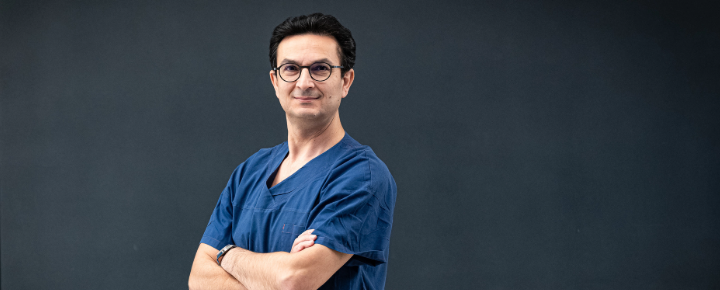
Al Muderis Osseointegration Clinic 

Al Muderis Osseointegration Clinic 

Pioneering expertise in the field of osseointegration for amputees .

Advanced treatment for limb reconstruction, lengthening, and deformity.

The Al Muderis Osseointegration Clinic delivers individualized, needs-led multidisciplinary care for a wide range of orthopaedic conditions. Lead by a highly experienced surgical team, it provides groundbreaking health care technologies, including 3D pre-surgical modelling and custom implant design, and dedicated inpatient facilities for all stages of the treatment journey, from initial assessment to post-operative rehabilitation. This includes specialist care for people with complications associated with diabetes, peripheral vascular disease, obesity and overweight, and poor bone quality.

Over 1500 amputees supported through osseointegration

More than 45,000 patients treated globally

25 years of care excellence

UAE’s only dedicated centre for limb loss and deformity care

Common Conditions & Subspecialty Clinics.

  • Ankle reconstruction, periprosthetic fracture, and pelvic/acetabular reconstruction
  • Robot-assisted arthroplasty and 3D printed implants
  • Shoulder and elbow replacement including advanced techniques
  • Primary and revision hip and knee replacement
  • Management of complex knee instability
  • ACL, PCL, MCL, LCL, and multi-ligament injury treatment

  • Orthopaedic management of CRPS
  • Growth plate injuries and pelvic/acetabular trauma
  • Tendon transfer, balancing, and ligament instability
  • Muscle imbalance, contractures, and mobility disorders
  • Cerebral palsy and post-polio deformity management
  • Chronic joint degeneration and severe osteoarthritis

  • Complex limb deformity and defect correction
  • Femoral and tibial lengthening with nails and frames
  • Angular and rotational correction
  • Guided growth in paediatric patients
  • Congenital deficiencies, joint replacement, tumour resection, and limb salvage
  • Foot deformity correction including clubfoot and flatfoot

Care Pathway & Coordination.

1
Immediate and Near-Term Consultation

Immediate and Near-Term Consultation

Introduction and assessment by a member of your surgical team, supported by a clinical management team who will support you on your journey.

2


Board review

Board review

Multidisciplinary internal case review, involving surgical, pain management, physiotherapist, prosthetist and rehabilitation team members responsible for your care.

3
  

Surgical planning

Surgical planning

Advanced preparation ahead of surgery, using 3D imaging to model each step of your surgery and the exact size and positioning of any implants to ensure the best possible outcome.

4


Surgery

Surgery

In-patient treatment including care excellence provided by expert members of your multidisciplinary care team.

5


Post-operative care and rehabilitation

Post-operative care and rehabilitation

Bespoke rehabilitation programme incorporating advanced physiotherapy, strength building and wellness optimizing techniques.

6


Long-term follow-up

Long-term follow-up

Long term health and functional monitoring, including regular follow-up consultations (completed remotely for international patients).

Technology & Facilities.

Comprehensive assessment and diagnosis for a range of orthopedic conditions.

3-D Pre-Surgical Modelling to optimize post-surgical outcomes.

EOS Low-Dose 3-D Imaging for accurate deformity and alignment assessment.

End-to-end limb loss, salvage and reconstruction care.

Individualised, needs-led rehabilitation and physiotherapy.

Long-term multidisciplinary aftercare.

Patient Specific Instrumentation (PSI) and custom 3D-printed titanium implants.

Patient-tailored concierge support for international and local referrals, appointments and travel.

Frequently Asked Questions.

What is osseointegration? 

Osseointegration is a breakthrough surgical technique that allows prosthetic limbs to be connected directly to the skeleton, eliminating the need for traditional sockets. The procedure involves the press-fit insertion of a titanium implant into the bone of the residual limb. Over a period of 4–6 weeks, new bone tissue grows into the porous surface of the implant, permanently anchoring it. A small portion of the implant is external, to enable a secure and direct connection to the prosthetic limb. By fixing the implant directly to the skeleton, osseointegration offers a range of benefits over traditional socket prosthetic use, including improvements in gait, mobility, stability, proprioception (the ability to sense external stimuli through the leg), pain reduction and patient-rated quality of life.

Who is suitable for osseointegration?

Not every person who wants osseointegration is a suitable candidate. However, recent technical and technological developments mean that the procedure is now available to more people than ever, including those with a diagnosis of insulin-dependent Diabetes, Peripheral Vascular Disease (PAD) and Complex Regional Pain Syndrome (CRPS). Conditions which may prevent osseointegration include active infection at the proposed surgical site (e.g., osteomyelitis), poorly controlled diabetes, osteoporosis or poor bone quality, immunosuppression or ongoing chemotherapy, organ transplant, pregnancy and historic irradiation of the bone (e.g. radiotherapy), as well as certain types of mental illness or psychiatric diagnoses. Lifestyle factors can also affect suitability. These can include poor levels of overall fitness, very advanced age (consistent with poor bone quality), and overweight and obesity. Smoking and vaping must be stopped at least three months ahead of surgery and, ideally, as far ahead of surgery as possible. Active smokers, and those engaged in substance abuse or chronic corticosteroid use, won't be considered for the procedure.

What can I expect from my surgery?

Before surgery, patients undergo comprehensive assessment and consultation to ensure suitability and prepare for their recovery. The procedure is typically performed in a single surgical stage. Surgery generally takes about two hours and may be paired with interventions to address neuropathic pain. Following surgery, patients begin a structured rehabilitation program that includes gradual “loading” of the implant to stimulate bone integration, along with strength training and Mobility exercises to support adaptation and progress. Most patients are able to walk unaided approximately four months after surgery.

What treatments are available for congenital deformities?

As a leading authority on limb deformity correction, Prof. Al Muderis and his team have helped to develop a suite of leading-edge surgical protocols for patients worldwide living with limb discrepancy, congenital absences, malalignment and deformity. He has helped to pioneer new techniques for precision osteotomy and bone lengthening, as well as new bespoke implant technologies for patients living with traumatic, arthritic and congenital injury and deformity. His innovative, minimally invasive techniques have been designed to optimise recovery time and improved post-surgical outcomes, ensuring a rapid return to work, recreation and family life for his patients.

What is limb lengthening?

Limb lengthening is a procedure designed to increase the length of one or more long bones in your arm or leg in order to address certain conditions that may result in shorter bone length, as well as post-traumatic Limb Length Discrepancies and as part of a suite of techniques to correct limb deformity. It involves cutting the bone and gradually separating the two parts over time. This gradual pulling apart of the target bone is known as distraction. Successful limb lengthening relies on the body’s ability to generate new bone (osteogenesis) in this surgically formed gap during the distraction phase, as well as the stretching of soft tissue, blood vessels and nerves around it. The distraction phase will last until a clinically safe lengthening target has been reached. It is followed by a consolidation phase, during which the newly formed bone hardens. An individual’s ability to lengthen is influenced by a variety of factors. These include adequacy of blood supply to the target area, bone quality, the presence of active osteomyelitis (bone infection), neurological disorders, a compromised immune system, lifestyle factors such as smoking or vaping or the use of drugs recreationally, as well as diagnoses of contraindicative mental health conditions.

Ready to Start Your Health Journey?

Take the first step towards better health with our expert team.

Book Appointment Contact Us