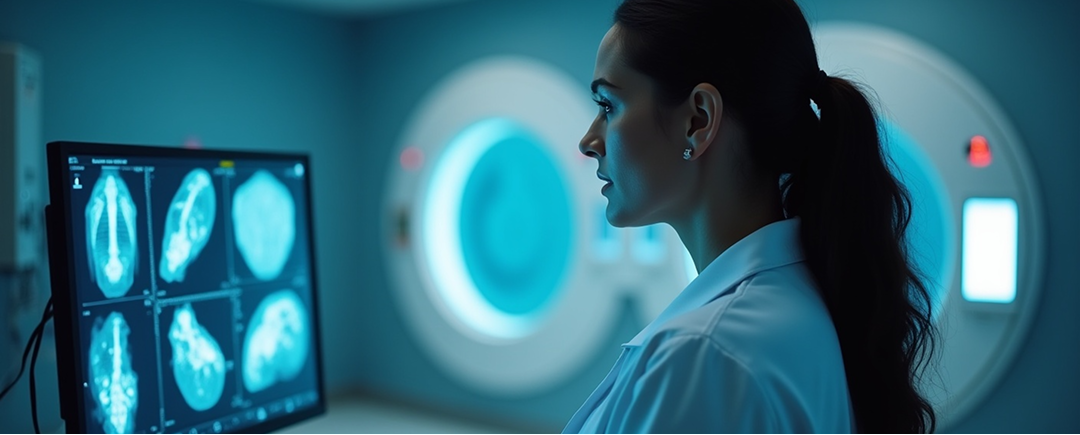
Nuclear Medicine
Precision Molecular Imaging & Targeted Radionuclide Therapy.
PET-CT, SPECT-CT, and theranostics that visualize and treat disease at the cellular level.
The Nuclear Medicine Department at Burjeel Medical City offers a comprehensive range of molecular imaging and targeted radionuclide therapies. Diagnostic services include PET/CT imaging with 68Ga-DOTATATE, PSMA tracers, 68Ga-FAPI, 18F-FDG, 18F-FES, 18F-FET, 18F-Choline, 18F-DOPA and 18F-amyloid tracers. The department also provides SPECT/CT studies for bone imaging, cardiac perfusion and amyloidosis, as well as lymphoscintigraphy, renal, gastric and endocrine studies, among others. An on-site radiopharmacy supports same-day tracer production and preparation, enabling a broad and responsive molecular imaging service. Targeted therapies include 177Lu-DOTATATE for neuroendocrine tumors, neuroblastoma and pheochromocytoma; 131I therapy for thyroid cancer; 177Lu-PSMA therapy for metastatic prostate cancer; and 90Y-radiolabeled microspheres, also known as selective internal radiation therapy (SIRT), for primary and metastatic liver tumors. Multidisciplinary theranostic boards support personalized treatment planning in collaboration with oncology, surgery and other relevant medical specialties.
Theranostic services implemented in accordance with international regulations and guidelines, supporting safe and structured delivery of molecular imaging and radionuclide therapy.
Common Conditions & Subspecialty Clinics.
- Low-dose 131I ablation therapy for thyroid cancer
- 177Lu-DOTATATE therapy for neuroendocrine tumors
- 90Y-microsphere therapy for liver tumors
- 177Lu-PSMA therapy for metastatic prostate cancer
- Three-phase bone scans and 18F-NaF imaging for orthopaedic conditions
- 18F-FDG imaging for osteomyelitis and fever of unknown origin
- Multi-tracer PET/CT and SPECT/CT protocols for the evaluation of prosthetic joint and implant-associated infections
- 18F-FDOPA and 99mTc-TRODAT imaging for Parkinsonian syndromes
- Cerebral metabolism PET/CT for epilepsy localization
- Amyloid PET and 18F-FDG PET imaging in Alzheimer’s disease and other dementias
- 18F-FET PET/CT for brain tumors
- 18F-FDG PET/CT and 68Ga-FAPI PET/CT for cancer staging and response assessment
- 68Ga-DOTATATE PET/CT for neuroendocrine tumors
- PSMA PET/CT for prostate cancer imaging
- 18F-FES PET/CT for selected breast cancer patients
- Radionuclide therapies, including 177Lu-DOTATATE, 177Lu-PSMA, 131I-NaI and 90Y-microspheres
- Thyroid uptake studies and scans for thyroid nodules and hyperthyroidism
- Parathyroid localization with SPECT/CT and PET/CT
- MIBG SPECT/CT for neuroblastoma, pheochromocytoma and paraganglioma
- Radioactive iodine (131I) therapy for hyperthyroidism and thyroid cancer
- Myocardial perfusion imaging with PET/CT and SPECT/CT
- MUGA scan for ejection fraction assessment
- Cardiac viability assessment with 18F-FDG PET
- Cardiac amyloidosis imaging with PYP
- Bone scans for the evaluation of skeletal metastases
- Renal scintigraphy, including DMSA scans for cortical defects and MAG3 scans for renal perfusion and drainage assessment
- Gastric emptying study for gastroparesis
- Hepatobiliary HIDA scans for suspected cholecystitis or bile leak
- Lymphoscintigraphy for lymphedema assessment and sentinel lymph node mapping
Procedures & Treatments.
Lymphoscintigraphy for lymphedema assessment and sentinel lymph node mapping
Myocardial perfusion imaging with PET/CT and SPECT/CT
Parathyroid localization with SPECT/CT and PET/CT
Thyroid uptake studies and scans for thyroid nodules and hyperthyroidism
Amyloid PET and ^18F-FDG PET imaging for Alzheimer’s disease and other dementias
18F-FET PET/CT for brain tumors
68Ga-FAPI PET/CT for cancer imaging
Post-therapy SPECT/CT imaging and dosimetry
Renal scintigraphy, including MAG3 scans for obstruction, perfusion and drainage assessment, and DMSA scans for cortical defects
Bone scans and bone SPECT/CT for occult fractures, orthopaedic conditions and skeletal metastases
PSMA PET/CT for high-risk and recurrent prostate cancer
68Ga-DOTATATE PET/CT for neuroendocrine tumor detection and PRRT eligibility assessment
18F-FES PET/CT for selected breast cancer patients
18F-FDG PET/CT for oncology staging, treatment response assessment, infection imaging and fever of unknown origin
90Y radioembolization with TheraSphere™ or SIR-Spheres® for primary and metastatic liver tumors (collaboration with Interventional Radiology)
177Lu-PSMA therapy for metastatic castration-resistant prostate cancer
177Lu-DOTATATE peptide receptor radionuclide therapy for metastatic or unresectable neuroendocrine tumors
177Lu-DOTATATE therapy for selected neuroblastoma and pheochromocytoma cases
Radioiodine (131I) therapy for hyperthyroidism and differentiated thyroid cancer ablation
Care Pathway & Coordination.

Referral & Indication Review
Nuclear physician verifies appropriateness; pre-authorization obtained.

Tracer Production & Scheduling
On-site radiopharmacy prepares radiotracer; patient scheduled within 1–3 days (imaging) or 1 week (therapy).
Imaging / Therapy Day
Patient receives tracer or therapeutic dose; imaging at specified time-points.
Image Reconstruction & Analysis
Motion correction is applied when required, with SUV quantification performed for PET/CT studies. For therapy cases, dosimetry calculations are performed by the medical physicist when clinically indicated
Report & Multidisciplinary Discussion
Reports are delivered within 2 working days. Complex cases are reviewed through multidisciplinary tumor board discussion when appropriate
Follow-Up
Post-therapy labs/imaging at 4–6 weeks; repeat cycles as protocol dictates; surveillance imaging schedule.